
Friday, 22 November 2013

Thursday, 22 August 2013
Dear Paprika: I Allowed A Doctor To Inject You With A Virus
Pepper talks to his daughter about
the wonders of immunization. Along the way, he teaches her about the
fascinating story of vaccination.
Dear Paprika,
Today, I read an article about anti-vacciners who are against vaccinating their children, “Under fire, vaccine deniers defend their choice”. They talked about how vaccines could cause autism in children, and harm their kids because vaccines are made from diseases and thus not foolproof. They also talked about how they are protecting their children from harm by “boosting their immune system” with home remedies and self medication.
I shook my head in disbelief when I read the article, never thinking for once this would happen in our country’s modern society.
I first heard of people speaking against vaccines a few years ago, after I watched a video of a cheerleader named Desiree Jennings who claimed a flu vaccination caused her to develop a neurological disorder. In the video, you can see she has lost her ability to walk normally except when walking backwards! Her story soon became the reason for rejecting vaccinations. Long story short, it was a sham.

The story of vaccination is a fascinating one. Take smallpox as an example. For thousands of years, there was no way to prevent it. People afflicted with the deadly smallpox developed red spots all over their body which would leave deep scars when they healed. Some even died from this disease. Nicknamed “speckled monsters”, everyone was afraid of contracting smallpox. Europeans conquering South America spread the disease there, while Africans brought to Europe as slaves spread it there. The disease was highly contagious and there was little anyone could do to stop it.
Edward Jenner, a doctor, once overheard a milkmaid who boasted that she would never get smallpox because she had had cowpox. Cowpox was a mild version of the smallpox. In 1796, Jenner took pus from a milkmaid who was suffering from cowpox and inoculated an 8 year old boy. The boy fell sick at first but soon got better. Later, when Jenner inoculated the boy with fresh smallpox, the boy did not develop the deadly disease! The boy had become immune to smallpox.
Immunisatin works by tricking the body. A mild or harmless version of a deadly disease is injected into a person. Our body’s natural immune system responds by producing antibodies to attack the disease. After that, it “remembers” how to fight the disease the next time it meets it again. Clever, right?
Now you know why you fall sick after being vaccinated; your body is just taking time to fight the disease. Yes, there is a minute chance complications could develop; a small group of people may be allergic to it but for 99.9% of us, there are almost zero risks. You see, before vaccines are approved, they undergo rigorious clinical trials. They are tested thousands of times over many years. Viruses mutate all the time and scientists work hard to find new vaccines to immunize people and stop the spread of diseases. Besides, your medical history is usually taken into consideration before you are vaccinated.
Some anti-vacciners argue, “Why take the risk at all?” Well, there is a risk you could die from crossing the road but we still do it every day. More accidents happen in our own homes than anywhere else! We take risks every day of our lives. On the contrary, the benefits of vaccination far outweigh the risks.
Some anti-vacciners argue that vaccines contain harmful chemicals like formaldehyde and mercury. Yes, they do. These chemicals are used to preserve and stabilise the vaccines. The amounts used are very small! When was the last time you heard of someone dying from an overdose of formaldehyde or mercury poisoning after being vaccinated? Here are some fun facts: a tuna sandwich contains 5 times more mercury than the flu vaccine. An infant breastfeeding from 6 months old receives 25 times more mercury than the flu vaccine.
If you think that is bad, did you know the US FDA allows a 24-ounce container of cornmeal to have up to 13 insects, 745 insect fragments and 27 rodent hairs in it? Yum! Even fresh vegetables are handled by many dirty hands, endure transportation from farm to market and spend hours in unsanitized places waiting to be bought by us. But a quick wash under tap water and we happily eat it without a second thought!
My point is, our bodies can handle such hazards without any problems.
The craziest argument against vaccination has to be “it is a tool used by the government to control the population”! Malaysia is spending RM16 billion on health care for the rakyat this year. Does that sound like a government that is out to harm its rakyat via its health care?

Disease outbreaks usually happen when too many people refuse to be vaccinated, allowing a disease to move easily through them, jumping from one person to another.
Here is how my friend Dr Kok Sen Wai explains it,
Dear Paprika, you and your brother have been vaccinated and immunised against multiple diseases. When you were a year old, you fell sick and we noticed red spots on your face. I called Auntie Su Lin who is a pediatrician. I asked if it was measles. She replied that it was impossible for you to contract measles as you had already been vaccinated and there was no outbreak of measles in Peninsular Malaysia. Thank you, vaccination!
If I meet a parent with concerns about vaccinating their children, I would try to reason with them as one parent to another – who wants only the best for our children – to trust the doctors who had to endure 5 years of expensive medical school and the subsequent few years as medical housemen to serve their fellowman. Trust the doctor, as he is looking out for your best interests. Immunize your children for their own sake.
Uncle Sen Wai (who is also a father-to-be) told me this interesting story. Dr. Ooi Mong How, one of the foremost paediatricians in our country and an expert on virally transmitted diseases, has this story he likes to tell: He was contacted by the Ministry of Health regarding a mysterious illness that had infected an entire rural village in Sarawak. People broke out in spots, pinkeye, cough and breathing problems – and the sickest, youngest and eldest patients died from it. So, they sent him down there to investigate and the moment he arrived, he recognised that mystery illness as something he used to see very commonly when he was a junior doctor – it was measles!
Measles has been so well prevented by vaccination that nowadays, we run the danger of younger, newer doctors (who have never seen it before in all their life and practice) fail to recognise a disease that older generations of doctors were able to diagnose at first sight. The outbreak occurred in that community because hardly anyone in it was vaccinated, so herd immunity was low and the measles virus spread like wildfire across the village.
The moral of that story is two-fold: One, vaccination is so effective that measles – a once common disease – is now so rare that many doctors can go through their careers without seeing even a single case. Two, when people do not vaccinate and herd immunity is low, the results can be fatally devastating.
Your loving father,
Daddy
This was written by Pepper Lim and edited by Dr Kok Sen Wai.
Dear Paprika,
Today, I read an article about anti-vacciners who are against vaccinating their children, “Under fire, vaccine deniers defend their choice”. They talked about how vaccines could cause autism in children, and harm their kids because vaccines are made from diseases and thus not foolproof. They also talked about how they are protecting their children from harm by “boosting their immune system” with home remedies and self medication.
I shook my head in disbelief when I read the article, never thinking for once this would happen in our country’s modern society.
I first heard of people speaking against vaccines a few years ago, after I watched a video of a cheerleader named Desiree Jennings who claimed a flu vaccination caused her to develop a neurological disorder. In the video, you can see she has lost her ability to walk normally except when walking backwards! Her story soon became the reason for rejecting vaccinations. Long story short, it was a sham.

Sweets and lollipops for everyone later! | Source: unicef.org
The story of vaccination is a fascinating one. Take smallpox as an example. For thousands of years, there was no way to prevent it. People afflicted with the deadly smallpox developed red spots all over their body which would leave deep scars when they healed. Some even died from this disease. Nicknamed “speckled monsters”, everyone was afraid of contracting smallpox. Europeans conquering South America spread the disease there, while Africans brought to Europe as slaves spread it there. The disease was highly contagious and there was little anyone could do to stop it.
Edward Jenner, a doctor, once overheard a milkmaid who boasted that she would never get smallpox because she had had cowpox. Cowpox was a mild version of the smallpox. In 1796, Jenner took pus from a milkmaid who was suffering from cowpox and inoculated an 8 year old boy. The boy fell sick at first but soon got better. Later, when Jenner inoculated the boy with fresh smallpox, the boy did not develop the deadly disease! The boy had become immune to smallpox.
Immunisatin works by tricking the body. A mild or harmless version of a deadly disease is injected into a person. Our body’s natural immune system responds by producing antibodies to attack the disease. After that, it “remembers” how to fight the disease the next time it meets it again. Clever, right?
Now you know why you fall sick after being vaccinated; your body is just taking time to fight the disease. Yes, there is a minute chance complications could develop; a small group of people may be allergic to it but for 99.9% of us, there are almost zero risks. You see, before vaccines are approved, they undergo rigorious clinical trials. They are tested thousands of times over many years. Viruses mutate all the time and scientists work hard to find new vaccines to immunize people and stop the spread of diseases. Besides, your medical history is usually taken into consideration before you are vaccinated.
Some anti-vacciners argue, “Why take the risk at all?” Well, there is a risk you could die from crossing the road but we still do it every day. More accidents happen in our own homes than anywhere else! We take risks every day of our lives. On the contrary, the benefits of vaccination far outweigh the risks.
Some anti-vacciners argue that vaccines contain harmful chemicals like formaldehyde and mercury. Yes, they do. These chemicals are used to preserve and stabilise the vaccines. The amounts used are very small! When was the last time you heard of someone dying from an overdose of formaldehyde or mercury poisoning after being vaccinated? Here are some fun facts: a tuna sandwich contains 5 times more mercury than the flu vaccine. An infant breastfeeding from 6 months old receives 25 times more mercury than the flu vaccine.
If you think that is bad, did you know the US FDA allows a 24-ounce container of cornmeal to have up to 13 insects, 745 insect fragments and 27 rodent hairs in it? Yum! Even fresh vegetables are handled by many dirty hands, endure transportation from farm to market and spend hours in unsanitized places waiting to be bought by us. But a quick wash under tap water and we happily eat it without a second thought!
My point is, our bodies can handle such hazards without any problems.
The craziest argument against vaccination has to be “it is a tool used by the government to control the population”! Malaysia is spending RM16 billion on health care for the rakyat this year. Does that sound like a government that is out to harm its rakyat via its health care?
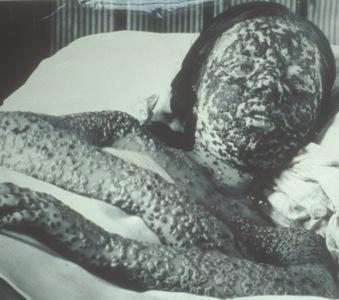
A speckled “smallpox” monster | Source: jennermuseum.com
Disease outbreaks usually happen when too many people refuse to be vaccinated, allowing a disease to move easily through them, jumping from one person to another.
Here is how my friend Dr Kok Sen Wai explains it,
“Germs are spread from one person to other people – that’s how these germs survive, making us sick as they go along. Vaccination turns people immune to these germs, and the more people in our community get vaccinated, the higher the herd immunity. If herd immunity is high, even when one non-vaccinated person falls sick, he is surrounded by vaccinated persons so that the germs cannot be as easily passed on to non-vaccinated persons.After all is said and done, don’t listen to quacks and self-proclaimed experts; listen to Dr Kok Sen Wai, a real medical doctor who spends his day curing sick people, “When you decide to vaccinate, you are not just protecting yourself. You are also helping to protect others at the same time.”
We have people who cannot be vaccinated, like newborn babies and those on whom vaccines don’t work because their immune systems don’t work properly. Herd immunity protects those people. When lots of people don’t vaccinate, the herd immunity goes down and germs can easily be passed between them, causing outbreaks. People who rely on the herd immunity to protect them would fall sick due to the bad decisions of people who do not vaccinate – while at the same time these selfish people benefit from the herd immunity they refuse to contribute to.”
Dear Paprika, you and your brother have been vaccinated and immunised against multiple diseases. When you were a year old, you fell sick and we noticed red spots on your face. I called Auntie Su Lin who is a pediatrician. I asked if it was measles. She replied that it was impossible for you to contract measles as you had already been vaccinated and there was no outbreak of measles in Peninsular Malaysia. Thank you, vaccination!
If I meet a parent with concerns about vaccinating their children, I would try to reason with them as one parent to another – who wants only the best for our children – to trust the doctors who had to endure 5 years of expensive medical school and the subsequent few years as medical housemen to serve their fellowman. Trust the doctor, as he is looking out for your best interests. Immunize your children for their own sake.
Uncle Sen Wai (who is also a father-to-be) told me this interesting story. Dr. Ooi Mong How, one of the foremost paediatricians in our country and an expert on virally transmitted diseases, has this story he likes to tell: He was contacted by the Ministry of Health regarding a mysterious illness that had infected an entire rural village in Sarawak. People broke out in spots, pinkeye, cough and breathing problems – and the sickest, youngest and eldest patients died from it. So, they sent him down there to investigate and the moment he arrived, he recognised that mystery illness as something he used to see very commonly when he was a junior doctor – it was measles!
Measles has been so well prevented by vaccination that nowadays, we run the danger of younger, newer doctors (who have never seen it before in all their life and practice) fail to recognise a disease that older generations of doctors were able to diagnose at first sight. The outbreak occurred in that community because hardly anyone in it was vaccinated, so herd immunity was low and the measles virus spread like wildfire across the village.
The moral of that story is two-fold: One, vaccination is so effective that measles – a once common disease – is now so rare that many doctors can go through their careers without seeing even a single case. Two, when people do not vaccinate and herd immunity is low, the results can be fatally devastating.
Your loving father,
Daddy
This was written by Pepper Lim and edited by Dr Kok Sen Wai.
Sunday, 11 August 2013
Saturday, 29 June 2013
How Not To Be A Monkey*
*With the exception of His Supreme Eminenceness Lord Bobo Barnabus, The Wonder Typewriting Monkey
Evolutionary psychology is retrodictive like evolutionary biology, but does not enjoy the same foundation as its well-established counterpart that has strong roots in many different fields of science, including paleontology, molecular biology, genetics and anthropology. Even the widely-held notion of evolutionary psychology that women were naturally monogamous was challenged by Dan Bergner, and has recently sparked public debate. The one thing that is certain, however, is that every decision that our ancestors have made, every adaptation, every stroke of genius or pure chance and every behavioural change has resulted in the social, sexual creatures that we are today. Our cousins, ranging from amoebas to giraffes, can also claim the glory of not being extinct (yet). But what sets our existence apart from all our other cousins?
Man has often put himself on a pedestal, towering above all other living matter. Especially in religion, the concept of man being just below god and above everything else has been entrenched in the minds of many. Setting the 'god' bit aside, the position that man has given himself is quite telling - we are a superior species, period. When asked why, the typical range of answers would be 'we are intelligent', 'we know what is wrong and right' (some research suggest otherwise - that animals have morality), etc.
Willie Poh Kaw Lik, a lecturer at Multimedia University tries to answer this, and boldly refuses to acknowledge that the answer to life is 42.
During his talk at Pusat Rakyat LB, 'How Not To Be A Monkey', Willie addressed two central questions: What makes us different, and what is our purpose in life? He began with a casual discussion (everything is casual when you see your lecturer in jeans and a fedora) on the personal, individual purpose of the men and women in the room, and related it to the generic, darwinian purpose of living beings - to survive and reproduce.
A comparison was drawn between a monkey's purpose in life to a human's purpose in life, and it undoubtedly tallied one way or another, with both organisms evidently trying to maximise its pleasure with the minimum amount of resource, and both cycles involving reproduction at some point.
A cute example of what was illustrated on the board was the parallels between 'scratching one's ass' (monkey) and 'having an iPad' (human) , which both contributes to the overall satisfaction of a person, benefiting the mental well-being of an individual, hence making him or her more likely to live longer and reproduce. Well, depression dramatically increases one's chances of dying from a heart attack, plus it kills the sex drive. That wasn't such a big leap, actually. Although merely a tiny fraction, it makes up a part of the innumerable joys that occasionally punctuate the rigmarole we call life.
Once the audience saw that the goals of a human and a monkey were not too different, Willie got them to think hard about what set humans from other animals. An animated discussion ensued, with interesting suggestions ranging from 'self-realisation' to 'opposable thumbs'. Willie was the alpha chimp of the session and eventually got everyone to agree with his hypothesis, which was 'language', as the unifying factor of all that is unique about our kind.
Being a friend of Willie, it was difficult not to agree with that bespectacled face of geekiness. He raised compelling points, which conveniently directed all other outlying points towards the crux of the matter that was 'language'. His contention was that without language, mankind would have not advanced as much as he has done. It is true that some species of animals have some form of language, however their language is extremely limited in function. Animals cannot string their vocalizations into grammatically organised sentences. Although whether chimps can actually use language like we do is still a hot topic and being debated by scientists, it is pretty much established that no one animal has displayed the complexity in its language that is comparable to ours. Which is why, Willie argues, we have managed to build things, plan things, and so on.
By 5pm, Willie moved on to the next big question: Why should we survive? Willie's next compelling idea was that the ultimate worthwhile purpose in life, that even goes beyond the banal goal to survive and reproduce, is to process information and gain knowledge. This is reminiscent of people who leave behind legacies, wanting their creations, their businesses, to outlast their lifetimes. He takes care to note that this is typical of a scientific worldview, and acknowledges that it may not resonate with some who subscribe to a more god-centric viewpoint. He tied this back to the previous question of what sets us apart from other animals - language - and said that since humans are the only species we know who can record information comprehensively and to gain more knowledge, this makes humans the best species to survive.
Interestingly, the discussion led to a string of hypothetical situations. One of them was: How would you feel if Earth was in the middle of a hyperspace bypass that would allow two superintelligent species to co-author The Encyclopedia Galactica? (Not verbatim. I just wanted to have another Hitchhiker reference.) Everyone in the audience enjoyed a lively discussion, despite the occasional confusion (which is what happens when one discusses philosophy).
To sum things up, one may say that the answer to the question of the day, 'how not to be a monkey', was more than 'not picking at one's arm pits'. It was to go beyond the cycle of 'survive --> reproduce', and create good in the world. To learn a second (or third, or fourth) language, because learning different languages gives one invaluable perspective on human behaviour and social interaction. Favour construction over destruction, conserve wisdom, learn from our mistakes. Most importantly, to not be a monkey, one must contribute to the betterment of mankind by adding to the knowledge we currently have by becoming a creator and not just a mere consumer.
Evolutionary psychology is retrodictive like evolutionary biology, but does not enjoy the same foundation as its well-established counterpart that has strong roots in many different fields of science, including paleontology, molecular biology, genetics and anthropology. Even the widely-held notion of evolutionary psychology that women were naturally monogamous was challenged by Dan Bergner, and has recently sparked public debate. The one thing that is certain, however, is that every decision that our ancestors have made, every adaptation, every stroke of genius or pure chance and every behavioural change has resulted in the social, sexual creatures that we are today. Our cousins, ranging from amoebas to giraffes, can also claim the glory of not being extinct (yet). But what sets our existence apart from all our other cousins?
Man has often put himself on a pedestal, towering above all other living matter. Especially in religion, the concept of man being just below god and above everything else has been entrenched in the minds of many. Setting the 'god' bit aside, the position that man has given himself is quite telling - we are a superior species, period. When asked why, the typical range of answers would be 'we are intelligent', 'we know what is wrong and right' (some research suggest otherwise - that animals have morality), etc.
Willie Poh Kaw Lik, a lecturer at Multimedia University tries to answer this, and boldly refuses to acknowledge that the answer to life is 42.
During his talk at Pusat Rakyat LB, 'How Not To Be A Monkey', Willie addressed two central questions: What makes us different, and what is our purpose in life? He began with a casual discussion (everything is casual when you see your lecturer in jeans and a fedora) on the personal, individual purpose of the men and women in the room, and related it to the generic, darwinian purpose of living beings - to survive and reproduce.
A comparison was drawn between a monkey's purpose in life to a human's purpose in life, and it undoubtedly tallied one way or another, with both organisms evidently trying to maximise its pleasure with the minimum amount of resource, and both cycles involving reproduction at some point.
 |
| Not preaching, but illustrating a life-purpose |
A cute example of what was illustrated on the board was the parallels between 'scratching one's ass' (monkey) and 'having an iPad' (human) , which both contributes to the overall satisfaction of a person, benefiting the mental well-being of an individual, hence making him or her more likely to live longer and reproduce. Well, depression dramatically increases one's chances of dying from a heart attack, plus it kills the sex drive. That wasn't such a big leap, actually. Although merely a tiny fraction, it makes up a part of the innumerable joys that occasionally punctuate the rigmarole we call life.
Once the audience saw that the goals of a human and a monkey were not too different, Willie got them to think hard about what set humans from other animals. An animated discussion ensued, with interesting suggestions ranging from 'self-realisation' to 'opposable thumbs'. Willie was the alpha chimp of the session and eventually got everyone to agree with his hypothesis, which was 'language', as the unifying factor of all that is unique about our kind.
 |
| Channelling his inner monkey. |
Being a friend of Willie, it was difficult not to agree with that bespectacled face of geekiness. He raised compelling points, which conveniently directed all other outlying points towards the crux of the matter that was 'language'. His contention was that without language, mankind would have not advanced as much as he has done. It is true that some species of animals have some form of language, however their language is extremely limited in function. Animals cannot string their vocalizations into grammatically organised sentences. Although whether chimps can actually use language like we do is still a hot topic and being debated by scientists, it is pretty much established that no one animal has displayed the complexity in its language that is comparable to ours. Which is why, Willie argues, we have managed to build things, plan things, and so on.
 |
| Spot the monkey in the room! |
By 5pm, Willie moved on to the next big question: Why should we survive? Willie's next compelling idea was that the ultimate worthwhile purpose in life, that even goes beyond the banal goal to survive and reproduce, is to process information and gain knowledge. This is reminiscent of people who leave behind legacies, wanting their creations, their businesses, to outlast their lifetimes. He takes care to note that this is typical of a scientific worldview, and acknowledges that it may not resonate with some who subscribe to a more god-centric viewpoint. He tied this back to the previous question of what sets us apart from other animals - language - and said that since humans are the only species we know who can record information comprehensively and to gain more knowledge, this makes humans the best species to survive.
Interestingly, the discussion led to a string of hypothetical situations. One of them was: How would you feel if Earth was in the middle of a hyperspace bypass that would allow two superintelligent species to co-author The Encyclopedia Galactica? (Not verbatim. I just wanted to have another Hitchhiker reference.) Everyone in the audience enjoyed a lively discussion, despite the occasional confusion (which is what happens when one discusses philosophy).
To sum things up, one may say that the answer to the question of the day, 'how not to be a monkey', was more than 'not picking at one's arm pits'. It was to go beyond the cycle of 'survive --> reproduce', and create good in the world. To learn a second (or third, or fourth) language, because learning different languages gives one invaluable perspective on human behaviour and social interaction. Favour construction over destruction, conserve wisdom, learn from our mistakes. Most importantly, to not be a monkey, one must contribute to the betterment of mankind by adding to the knowledge we currently have by becoming a creator and not just a mere consumer.
Tuesday, 25 June 2013
The Haze: Do's and Don'ts
As suggested by the APOSL science club
It does look as though the haze is here to stay for a couple of months. While the various politicians battle it out with a war of words, let's leave them to it and do what we can to protect ourselves.


Ref.:
1) http://www.colorado.gov/cs/Satellite?blobcol=urldata&blobheadername1=Content-Disposition&blobheadername2=Content-Type&blobheadervalue1=inline%3B+filename%3D%22Fire+and+smoke+FAQ.pdf%22&blobheadervalue2=application%2Fpdf&blobkey=id&blobtable=MungoBlobs&blobwhere=1251856472340&ssbinary=true
2) http://publichealth.nc.gov/docs/news/FrequentlyAskedQuestionsRegardingHealthAndWildfires.pdf
3) http://www.epa.gov/iaq/pubs/ozonegen.html
4) http://nmhealth.org/eheb/documents/SmokeandMasks61011.pdf
5) http://oehha.ca.gov/air/risk_assess/wildfirev8.pdf
It does look as though the haze is here to stay for a couple of months. While the various politicians battle it out with a war of words, let's leave them to it and do what we can to protect ourselves.
Do's:

- Shut the windows (including the windows in your bathroom) and doors of your house and stay indoors.
- Check the DOE's Air Pollutant Index daily. (http://apims.doe.gov.my/apims/) Any numbers higher than 200 are very unhealthy.
- Consider buying a “N95” respirator to use for when you go out. Read the instructions and learn to wear it correctly.. The method of using one can vary depending on the model and manufacturer – always consult your doctor first. Remember that respirators are usually unsuitable for children and pregnant women, and if you are a man, it will be required that you shave your facial hair to ensure the mask can form a proper seal.(1)(2)
- Use the air-conditioner as it can also help filter the air. If at all possible, consider replacing your air-conditioner filters with HEPA filters, high efficiency filters that remove fine particles from the air.
- To save money, have the entire family sit together in the room and take this opportunity to bond. Watch some television (Game of Thrones marathon anyone?), play tabletop games or simply break out the iPads and laptops. We recommend watching videos from TED, as there are quite literally hundreds of hours of useful and interesting knowledge to broaden one's horizons. (5)
- Go to an indoor gym more often. Restricting oneself indoors is no excuse to sit around all day and be lazy. Exercising outdoors has clearly become a liability, so why not take a quick drive and enrol in your nearest gym. The cheaper alternative is to work out at home. Stretching exercises are recommended as they don't take up much space and you still get the some of the benefits of exercise. Consider investing in a yoga mat.
- When driving to work, look for the recirculate button in your car. Most cars have this function. This keeps the particulate counts in your car lower(1)
- Turn on the air-purifier if you have one. Remember to check and clean the filters in the air-conditioners and purifier regularly to keep them operating at maximum efficiency.
- Have a bottle of eye-drops handy for those who suffer from eye-irritation.
- Keep hydrated by drinking plenty of water.
- Wash your hands and face when entering from outdoors. Dust particles are essentially breeding grounds for bacteria.
- Shower and change into a fresh set of clothes as soon as you come home.
Do-nots:
- Do not use surgical masks and wet bandanas. They are poor substitutes and are not recommended for use as they do not form proper seals on the face to prevent you from inhaling unfiltered air.(2)(4)
- Do not smoke or burn anything inside the house, such as candles or incense, as this will increase the amount of dust indoors.(5)
- Do not use ozone generators to purify the air. This may be more dangerous than it's worth.(1)(3)(5)

Ref.:
1) http://www.colorado.gov/cs/Satellite?blobcol=urldata&blobheadername1=Content-Disposition&blobheadername2=Content-Type&blobheadervalue1=inline%3B+filename%3D%22Fire+and+smoke+FAQ.pdf%22&blobheadervalue2=application%2Fpdf&blobkey=id&blobtable=MungoBlobs&blobwhere=1251856472340&ssbinary=true
2) http://publichealth.nc.gov/docs/news/FrequentlyAskedQuestionsRegardingHealthAndWildfires.pdf
3) http://www.epa.gov/iaq/pubs/ozonegen.html
4) http://nmhealth.org/eheb/documents/SmokeandMasks61011.pdf
5) http://oehha.ca.gov/air/risk_assess/wildfirev8.pdf
Saturday, 1 June 2013
Conversation: So, How Does Ointment Work?
I asked this question on the APOSL Facebook page: www.facebook.com/groups/aposlmy
Kenny Lim: Also I should mention that ointment and cream are slightly different in formulation. Both consist of an emulsion(mixture) of oil and water with a surfactant(it holds the oil and water together) but ointment is usually more "Oily". Most people prefer creams over ointments when it comes to skin conditions because it doesn't leave a greasy mark when you apply it, but generally ointments are better as protective agents(prevent the skin from drying out)
Imran Radzmi: Oooh didn't know steroids interfere with protein synthesis too! How exactly does this occur? I always assumed the swelling is caused from migration of plasma into interstitial fluid in tissue, and steroids would surely cause the latter at least, since it interferes with immunity responses of which inflammation is one of em, interleukins and whatnot
Imran Radzmi: I always found it strange that we cripple the body's natural response to wound healing with anti-inflammatories though, aside from say deletrious immune responses
Kenny Lim: Well generally inflammation is not bad when you talk about bruises and wounds. There's a lengthy article here that explains in detail how steroids (glucocorticoids) work http://www.ncbi.nlm.nih.gov/pmc/articles/PMC1751559/
How corticosteroids control inflammation: Quintiles Prize Lecture 2005
www.ncbi.nlm.nih.gov
Imran Radzmi: Fulamak, ok i'll try and read this.
In any case, inflammation helps recovery by reducing blood flow so that fibrin can condense more efficiently ka?
Kenny Lim: No it increases blood flow. So you can get the white blood cells into the inflammation site(in case of infection) and also heat up the area to speed up the process of healing. The idea is to kill off foreign bodies, clean up any foreign material(usually inflammation is initiated by damaged tissue, which floats around and is eaten up by macrophages) and start with the repair process.
Kok Sen Wai: You will be surprised to know how many diseases kills us not on its own but by causing our own body to hurt itself. I haven't counted but I think it might even be in the majority. That's why corticosteroids is a favourite of quack physicians (Chinese TCM practitioners especially, I understand). It really is a wonder drug. The reason why we in mainstream medicine is more reticent in using it willy nilly is that it can cause serious, serious side effects in the long run. Quacks that just want to quickly relieve your obvious symptoms (thus demonstrating how superior they are) have no such qualms.
I got many people telling me how wonderful their TCM doctor is because they managed to "cure" their disease when their Western doctors can't. That's because we aren't into unscrupulous use of corticosteroids. I have seen many people coming in with Cushing's Syndrome from these sort of therapy.
Imran Radzmi: Kenny- Increases blood flow? I always assumed all that swelling would impinge on the vasculature and cause constriction. It's the opposite? There is the heating effect but that can be explained by the increased blood flow..so how is flow increased?
Kok-Yeowch, do you mean ailments like autoimmune disorders and anaphylaxis. Which still makes it strange to me. Then again the basis for autoimmune diseases isn't really understood yeah?
Yeah that makes sense, since most who approach TCM, aside from terminal diseases probably do so for treatment of chronic pain like say poking needles into your arthritic knees lol
All this talk of painkillers reminds me of a study that showed a correlation between elevation of mood and ingestion of anti-inflammatories and pyretics. One could surmise the body that goes into a state of repair might decrease activity and excitability and this might have neurological effects as well. Only read that one study though, and it was a small sample size i think
Kenny Lim: No no, it's the other way around. The vasodilation increases blood flow, and the blood vessels become more "leaky" which allow macrophages and other proteins to enter the affected area, which causes the fluid to leak into the site of inflammation causing the swelling.
Imran Radzmi: Yeah that's what i meant, vasodilation increases blood flow, but i was wondering how swelling which should constrict the vasculature, increase blood flow, but you just answered that by mentioning permeability, which i should have understood anyway given that i mentioned interstitial fluid...stupid me
Imran Radzmi: So it's not necessarily blood flow, but mainly leakage from the vessels isn't it?
Kenny Lim: Well I mentioned vasodilation earlier. That increases the blood flow. As you should know, blood is made of one part plasma too. That fluid leaks out of the blood vessels, making it swell.
Imran Radzmi: Yeah, but you didn't mention where the vasodilation comes from? I was asking if the vasodilation itself was directly CAUSED by the swelling. So, the vasodilation that accompanies wounds and such, occurs separately?
Kenny Lim: That would be histamine and nitric oxide released when tissues are damaged. http://www.daftblogger.com/vascular-response-in-acute-inflammation/
Vascular Response in Acute Inflammation | Daft Blogger - Making it accessible
www.daftblogger.com
Kenny Lim: If you want a bit more detail, you can find mast cells in connective tissue, which contains a resevoir of histamine. When the tissue breaks, mast cells release histamine, and inflammation starts.
Imran Radzmi: Ahh nitric oxide is released, no wondahh.
Pepper Lim: We should make an info graphic to explain this.
Pepper Lim: Kenny, could you break down your explanation on how ointment works into 4 or 5 panels that I can draw? Simple explanation please.
Kenny Lim: Again, going to assume you mean hydrocortisone. I'd start off by explaining what happens in inflammation. In a wound or a bruise, connective tissue is damaged. Histamine is released from this broken tissue, causing vasodilation, cytokines(proteins) are also released, which recruit white blood cells like monocytes(more proteins) which chomp up all the broken and dead tissue. Vasodilation causes increased blood flow and osmotic pressure goes up. Intersitial fluid leaks into the site of inflammation, causing swelling. Hydrocortisone cream interferes with DNA synthesis, which reduces the production of pro-inflammatory proteins, thus reducing swelling.
Pepper Lim: Let me take out my dictionary and try to make sense of it first before I attempt to draw it.
Question: So, how does ointment work? When you apply ointment on your skin for an insect bite, how does it heal the sting? Or, doesn't it?
Kenny Lim: Well it depends on what you use, but normally what we sell in the UK is an anti-inflammatory steroid cream like hydrocortisone 1%. The steroids mess about with the protein synthesis in cells and reduces the inflammation.Kenny Lim: Also I should mention that ointment and cream are slightly different in formulation. Both consist of an emulsion(mixture) of oil and water with a surfactant(it holds the oil and water together) but ointment is usually more "Oily". Most people prefer creams over ointments when it comes to skin conditions because it doesn't leave a greasy mark when you apply it, but generally ointments are better as protective agents(prevent the skin from drying out)
Imran Radzmi: Oooh didn't know steroids interfere with protein synthesis too! How exactly does this occur? I always assumed the swelling is caused from migration of plasma into interstitial fluid in tissue, and steroids would surely cause the latter at least, since it interferes with immunity responses of which inflammation is one of em, interleukins and whatnot
Imran Radzmi: I always found it strange that we cripple the body's natural response to wound healing with anti-inflammatories though, aside from say deletrious immune responses
Kenny Lim: Well generally inflammation is not bad when you talk about bruises and wounds. There's a lengthy article here that explains in detail how steroids (glucocorticoids) work http://www.ncbi.nlm.nih.gov/pmc/articles/PMC1751559/
How corticosteroids control inflammation: Quintiles Prize Lecture 2005
www.ncbi.nlm.nih.gov
Imran Radzmi: Fulamak, ok i'll try and read this.
In any case, inflammation helps recovery by reducing blood flow so that fibrin can condense more efficiently ka?
Kenny Lim: No it increases blood flow. So you can get the white blood cells into the inflammation site(in case of infection) and also heat up the area to speed up the process of healing. The idea is to kill off foreign bodies, clean up any foreign material(usually inflammation is initiated by damaged tissue, which floats around and is eaten up by macrophages) and start with the repair process.
Kok Sen Wai: You will be surprised to know how many diseases kills us not on its own but by causing our own body to hurt itself. I haven't counted but I think it might even be in the majority. That's why corticosteroids is a favourite of quack physicians (Chinese TCM practitioners especially, I understand). It really is a wonder drug. The reason why we in mainstream medicine is more reticent in using it willy nilly is that it can cause serious, serious side effects in the long run. Quacks that just want to quickly relieve your obvious symptoms (thus demonstrating how superior they are) have no such qualms.
I got many people telling me how wonderful their TCM doctor is because they managed to "cure" their disease when their Western doctors can't. That's because we aren't into unscrupulous use of corticosteroids. I have seen many people coming in with Cushing's Syndrome from these sort of therapy.
Imran Radzmi: Kenny- Increases blood flow? I always assumed all that swelling would impinge on the vasculature and cause constriction. It's the opposite? There is the heating effect but that can be explained by the increased blood flow..so how is flow increased?
Kok-Yeowch, do you mean ailments like autoimmune disorders and anaphylaxis. Which still makes it strange to me. Then again the basis for autoimmune diseases isn't really understood yeah?
Yeah that makes sense, since most who approach TCM, aside from terminal diseases probably do so for treatment of chronic pain like say poking needles into your arthritic knees lol
All this talk of painkillers reminds me of a study that showed a correlation between elevation of mood and ingestion of anti-inflammatories and pyretics. One could surmise the body that goes into a state of repair might decrease activity and excitability and this might have neurological effects as well. Only read that one study though, and it was a small sample size i think
Kenny Lim: No no, it's the other way around. The vasodilation increases blood flow, and the blood vessels become more "leaky" which allow macrophages and other proteins to enter the affected area, which causes the fluid to leak into the site of inflammation causing the swelling.
Imran Radzmi: Yeah that's what i meant, vasodilation increases blood flow, but i was wondering how swelling which should constrict the vasculature, increase blood flow, but you just answered that by mentioning permeability, which i should have understood anyway given that i mentioned interstitial fluid...stupid me
Imran Radzmi: So it's not necessarily blood flow, but mainly leakage from the vessels isn't it?
Kenny Lim: Well I mentioned vasodilation earlier. That increases the blood flow. As you should know, blood is made of one part plasma too. That fluid leaks out of the blood vessels, making it swell.
Imran Radzmi: Yeah, but you didn't mention where the vasodilation comes from? I was asking if the vasodilation itself was directly CAUSED by the swelling. So, the vasodilation that accompanies wounds and such, occurs separately?
Kenny Lim: That would be histamine and nitric oxide released when tissues are damaged. http://www.daftblogger.com/vascular-response-in-acute-inflammation/
Vascular Response in Acute Inflammation | Daft Blogger - Making it accessible
www.daftblogger.com
Kenny Lim: If you want a bit more detail, you can find mast cells in connective tissue, which contains a resevoir of histamine. When the tissue breaks, mast cells release histamine, and inflammation starts.
Imran Radzmi: Ahh nitric oxide is released, no wondahh.
Pepper Lim: We should make an info graphic to explain this.
Pepper Lim: Kenny, could you break down your explanation on how ointment works into 4 or 5 panels that I can draw? Simple explanation please.
Kenny Lim: Again, going to assume you mean hydrocortisone. I'd start off by explaining what happens in inflammation. In a wound or a bruise, connective tissue is damaged. Histamine is released from this broken tissue, causing vasodilation, cytokines(proteins) are also released, which recruit white blood cells like monocytes(more proteins) which chomp up all the broken and dead tissue. Vasodilation causes increased blood flow and osmotic pressure goes up. Intersitial fluid leaks into the site of inflammation, causing swelling. Hydrocortisone cream interferes with DNA synthesis, which reduces the production of pro-inflammatory proteins, thus reducing swelling.
Pepper Lim: Let me take out my dictionary and try to make sense of it first before I attempt to draw it.
Sunday, 28 April 2013
Sunday, 17 March 2013
Intelligent Design vs Evolution Forum 16.3.13
APOSL's members were put to the test when we defended the theory of evolution against Intelligent Design (ID). Defending ID was a Christian group called The Young Apologists. They were represented by Prof Living (a retired professor of geology from one of the top universities in Malaysia) and Pastor Samuel Nesan (a young pastor who is currently pursuing his theological studies in a local bible college).
From APOSL, Navin Innasi (an IT student) and Nathalie Kee (an A-levels student) defended evolution.
Before the forum, we took a poll: ID received 9 votes and evolution received 27 votes.
After the forum, ID received 14 votes and evolution received 19 votes.
Watch the video for yourself.
From APOSL, Navin Innasi (an IT student) and Nathalie Kee (an A-levels student) defended evolution.
Before the forum, we took a poll: ID received 9 votes and evolution received 27 votes.
After the forum, ID received 14 votes and evolution received 19 votes.
Watch the video for yourself.
Tuesday, 26 February 2013
Local Science Club Celebrates Darwin's Birthday
KUALA LUMPUR, Feb 23 - A local science club in Kuala Lumpur organised an event to celebrate the birthday of notable naturalist Charles Darwin. Darwin who was born on 12 February 1809 became world famous after he proposed his scientific theory called "natural selection". His book On The Origin Of Species, published in 1859, presented a body of evidence that life evolved through a process of natural selection; the strong continue to propagate while the weak eventually die out.
This free event was open to all and organised by APOSL, a science club whose acronym stands for "Advocates of the Propagation of Science Literacy". It held at Loyarburok's Pusat Rakyat LB in Bangsar, Kuala Lumpur. The club's aim is to help promote science and sceptical thinking.
When the guests came in, each one was given a banana and a large cookie decorated with a fish with legs. The banana and legged fish were later explained by Nathalie Kee, an 18 year old student. She explained, "The banana we enjoy today is actually a man made 'natural selection'. Bananas in the wild are small and filled with seeds. Over the years, we have selected and only planted the types of bananas that give us the desired shape, quality and taste. The fish with legs symbolises evolution. There is an extincted fish called Ichthyostega which had limbs like legs." She was also quick to emphasise that the cookie is not to snub the Christian symbol "ichthys".
 |
| Specially made birthday cake for Charles Darwin | Souce: Ho Kian Kheong |
 |
| "I think" | Source: Wikipedia.org |
Pusat Rakyat LB was decorated with posters about Darwin's life and his work. Guests were encouraged to read the bytes of information to learn more about him. An interesting fact I found while reading the poster was that the Church Of England issued an official apology for criticising Darwin, in 2008.
Hari Darwin gave the opportunity for many of the guests to meet. Most of them have only met each other online at APOSL's Facebook page and were happy to meet one another in real life.
Ho Kian Kheong, a genetics and molecular biologist, presented a short biography of Charles Darwin. It seems Darwin procastinated 20 years before presenting his theory until another scientist named Alfred Wallace wrote to him and presented him with the same idea Darwin was working on. Being a gentleman, Darwin presented both ideas to the Linnean Society of London.
There were also sing-along songs about Darwin sung to the tune of The Beatles' Revolution and the opening theme to The Big Bang Theory, a comedy television series.
The club baked a special cake depicting the evolution of human beings and sang a rowdy "happy birthday" for Darwin.
The most interesting part of the day's programme was left to the end: a screening of a 3D documentary. The audience was handed reb-blue 3D spectacles for viewing the documentary about modern scientists who returned to the Galapagos Islands to continue the study Darwin started almost 200 years ago.
Darwin's birthday is celebrated all over the world on or around 12 February. Schools, universities and science enthusiasts ahve been celebrating his birthday since 1882.
Hari Darwin gave the opportunity for many of the guests to meet. Most of them have only met each other online at APOSL's Facebook page and were happy to meet one another in real life.
Ho Kian Kheong, a genetics and molecular biologist, presented a short biography of Charles Darwin. It seems Darwin procastinated 20 years before presenting his theory until another scientist named Alfred Wallace wrote to him and presented him with the same idea Darwin was working on. Being a gentleman, Darwin presented both ideas to the Linnean Society of London.
There were also sing-along songs about Darwin sung to the tune of The Beatles' Revolution and the opening theme to The Big Bang Theory, a comedy television series.
The club baked a special cake depicting the evolution of human beings and sang a rowdy "happy birthday" for Darwin.
The most interesting part of the day's programme was left to the end: a screening of a 3D documentary. The audience was handed reb-blue 3D spectacles for viewing the documentary about modern scientists who returned to the Galapagos Islands to continue the study Darwin started almost 200 years ago.
 |
| Audience enjoying a 3D documentary at Hari Darwin | Source: Pepper Lim |
Sunday, 20 January 2013
APOSL T-Shirts and Our Future Plans
Hello! APOSL is up and running for 2013 and we have a ton of new events throughout the first half of 2013 that should keep you and us busy for some time. I'll get to that but first off, APOSL is selling our T-shirts as below:
 Get them RM35 if you order online, RM40 if you get them at our events. Please contact
We still have the old designs available, so if you prefer please email swag@aposl.org for more information.
Meantime we do have a slew of new events coming up soon, starting off with our Darwin Day celebrations on 23th February 2013 at Pusat Rakyat LoyarBurok. This is a (hopefully!) annual event celebrating the life and impact of Charles Darwin and his successors in the scientific worlds his theory touched.
Get them RM35 if you order online, RM40 if you get them at our events. Please contact
We still have the old designs available, so if you prefer please email swag@aposl.org for more information.
Meantime we do have a slew of new events coming up soon, starting off with our Darwin Day celebrations on 23th February 2013 at Pusat Rakyat LoyarBurok. This is a (hopefully!) annual event celebrating the life and impact of Charles Darwin and his successors in the scientific worlds his theory touched.
We will also be hosting an Intelligent Design and Evolution Debate on 16th March 2013 also at Pusat Rakyat Loyarburok, where a group of Young Apologist Christians has graciously decided to debate our speakers about the finer points of evolution. Then we'll have pie, because Pi day is on March 14th. Or maybe half a pie.
Coming in May or later we will continue to have talks once a month as best we can, as well as a workshop for the younger folks. Stay tuned for more information, and remember to like our Facebook group for more up-to-date information and lively debates!
Meanwhile here's some pictures from our last event with Petroleum Engineer Juli Jamaluddin, From Dinosaurs to Dollars.


We will also be hosting an Intelligent Design and Evolution Debate on 16th March 2013 also at Pusat Rakyat Loyarburok, where a group of Young Apologist Christians has graciously decided to debate our speakers about the finer points of evolution. Then we'll have pie, because Pi day is on March 14th. Or maybe half a pie.
Coming in May or later we will continue to have talks once a month as best we can, as well as a workshop for the younger folks. Stay tuned for more information, and remember to like our Facebook group for more up-to-date information and lively debates!
Meanwhile here's some pictures from our last event with Petroleum Engineer Juli Jamaluddin, From Dinosaurs to Dollars.


Subscribe to:
Comments (Atom)